
In the IBM mainframe era, governments, large companies, and specialists controlled computing power. Personal computers brought it to everyone’s desk. Smartphones put it in everyone’s pocket.
At Apollo Next, Howie Liu, CEO of Hyperagent, used that progression to explain what is happening with AI agents. Powerful capabilities still require a lot of work to assemble, but the interface is getting simpler. “You shouldn’t have to learn prompt engineering,” he said. “You shouldn’t have to learn advanced configuration.”
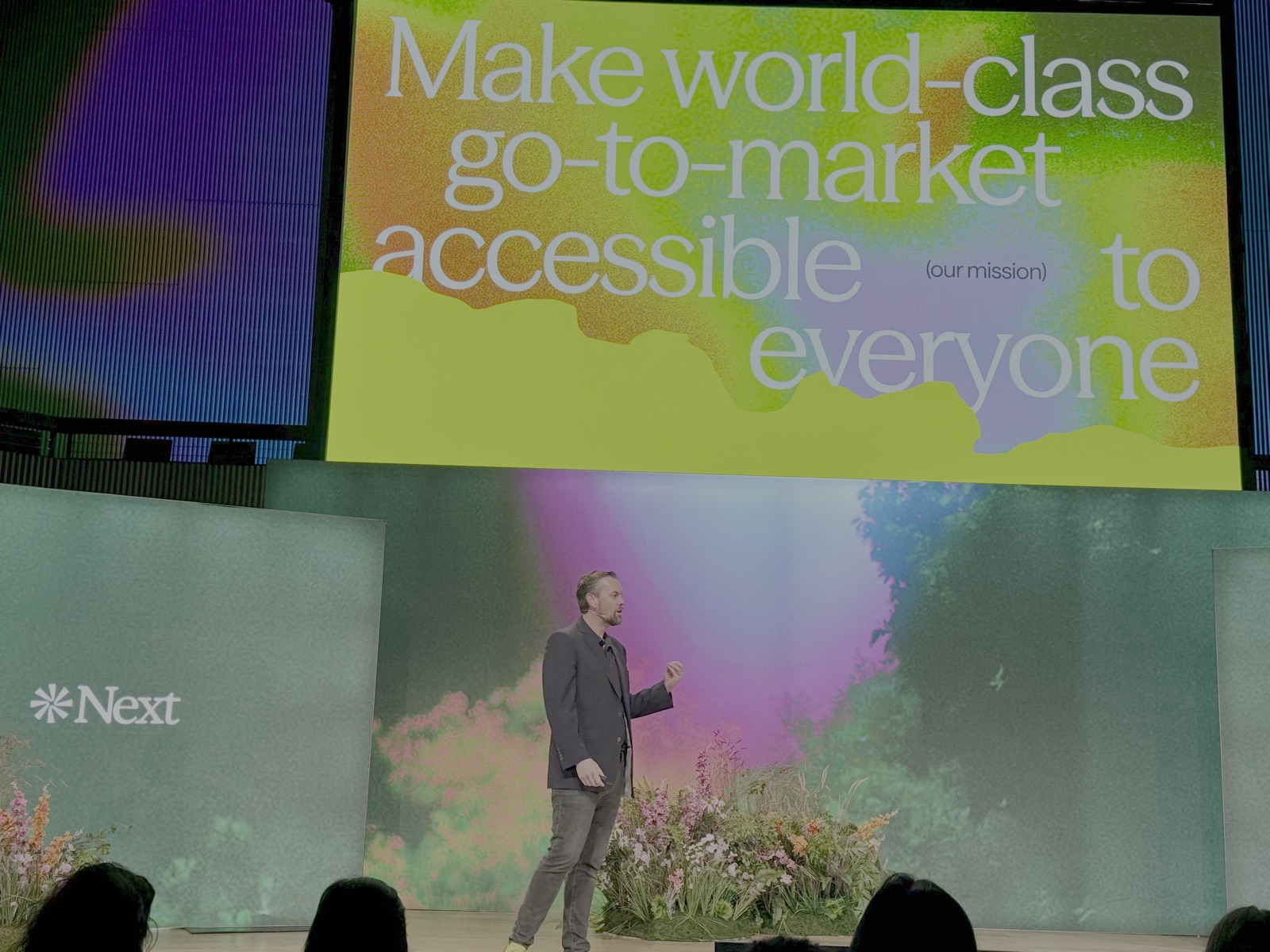
That was the theme of the Apollo conference. The tools and expertise required to build a sophisticated go-to-market system are becoming accessible to teams that could never have afforded the engineering, RevOps staff, and software stack behind one. Apollo’s ambition is to package much of that system in one platform.
My take is twofold: Apollo’s vision is impressive. For a cybersecurity marketing team it still falls short of being truly all-in-one.
What Apollo announced
Apollo organized its new AI GTM system around data, intelligence, and execution. Three announcements give that framework substance:
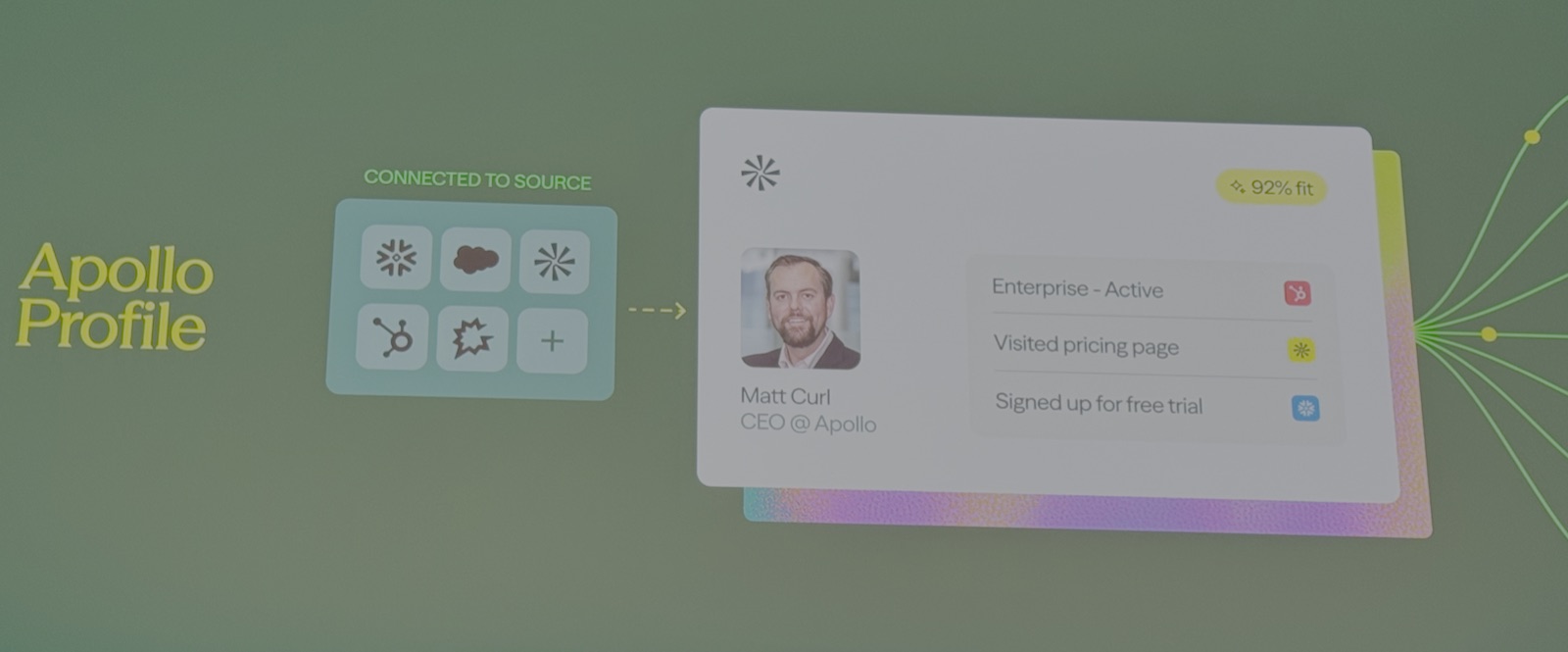
- The Intelligence Layer combines Apollo Intelligence Profile, a continuously updated view of people and accounts, with GTM Harness, which uses that context to recommend and carry out actions. Apollo says this layer is available now.
- Messaging OS extends Apollo into marketing email campaigns and Google Ads audiences alongside its existing sales outreach. It is in closed beta.
- Builder Studio lets a GTM team describe a needed app or workflow in natural language, then build it on Apollo’s data and execution capabilities. It is also in closed beta.
My take on Apollo Profile is that it is a customer data platform (CDP) adapted for GTM: bringing account, contact, engagement, CRM, and external signals into a shared picture that people and agents can act on. Small teams can now work from a high-fidelity account picture without building the underlying infrastructure.
Mark Sieglock, Chief Product Officer at Apollo, made the vision more concrete in his product demo. A rep’s home screen surfaced recent signals, prioritized tasks, and prepared meeting briefings. Apollo drafted outreach with account context and showed its reasoning. Call intelligence created follow-up tasks. A sequence optimizer proposed changes that a RevOps user could approve from Slack or access through tools such as Claude.
Mark’s summary: “One connected system, not disparate tools.”
That breadth is Apollo’s greatest strength. Contact and account data, signals, a sequencer, a dialer, call insights, email deliverability tools, calendaring, marketing campaigns, and a natural-language builder can all inform the same workflow. The interface is dense, but I can see the appeal of having so much capability in one place. For a lean team, that means less time stitching tools together and more time putting them to work.
The rest of the conference explained what becomes valuable
Apollo’s launches fit a shift the other speakers were seeing from different angles.
On the Building for Builders panel, Chris Thompson, Applied AI Architect at Anthropic, said that a GTM team member can now turn an idea into an app in hours. A year ago, that often meant an engineering request and a sprint. The new requirement, he argued, is “having a really good idea”: identifying a problem worth solving, building for the full workflow, and checking whether the result moves the intended number.
Tessa del Rio, Vice President, Upmarket at HubSpot, described account executives starting their day with signals, a possible buyer committee, and draft outreach already prepared. Instead of assembling all that work themselves, they must decide whether it is right: Is this the correct account? Are these the right people? Is the message pointed enough to send? Her hiring question captured the change: “How do you hire and coach on judgment?”
The morning AI GTM panel pushed the point further. Jordan Spence, Head of Sales Technology & AI at FIS, said: “I used to believe AI maturity in an organization was directly related to AI coverage. You have 100 processes, 90% of them are automated through AI … I was wrong.” The more valuable approach is to focus on the friction that matters most to sellers. Lexi Riggs, VP, Revenue Strategy and Chief of Staff at DigitalOcean, supplied a useful test for the resulting work: “That judgment is not sending more AI output. It’s knowing what’s actually important and being able to edit.”
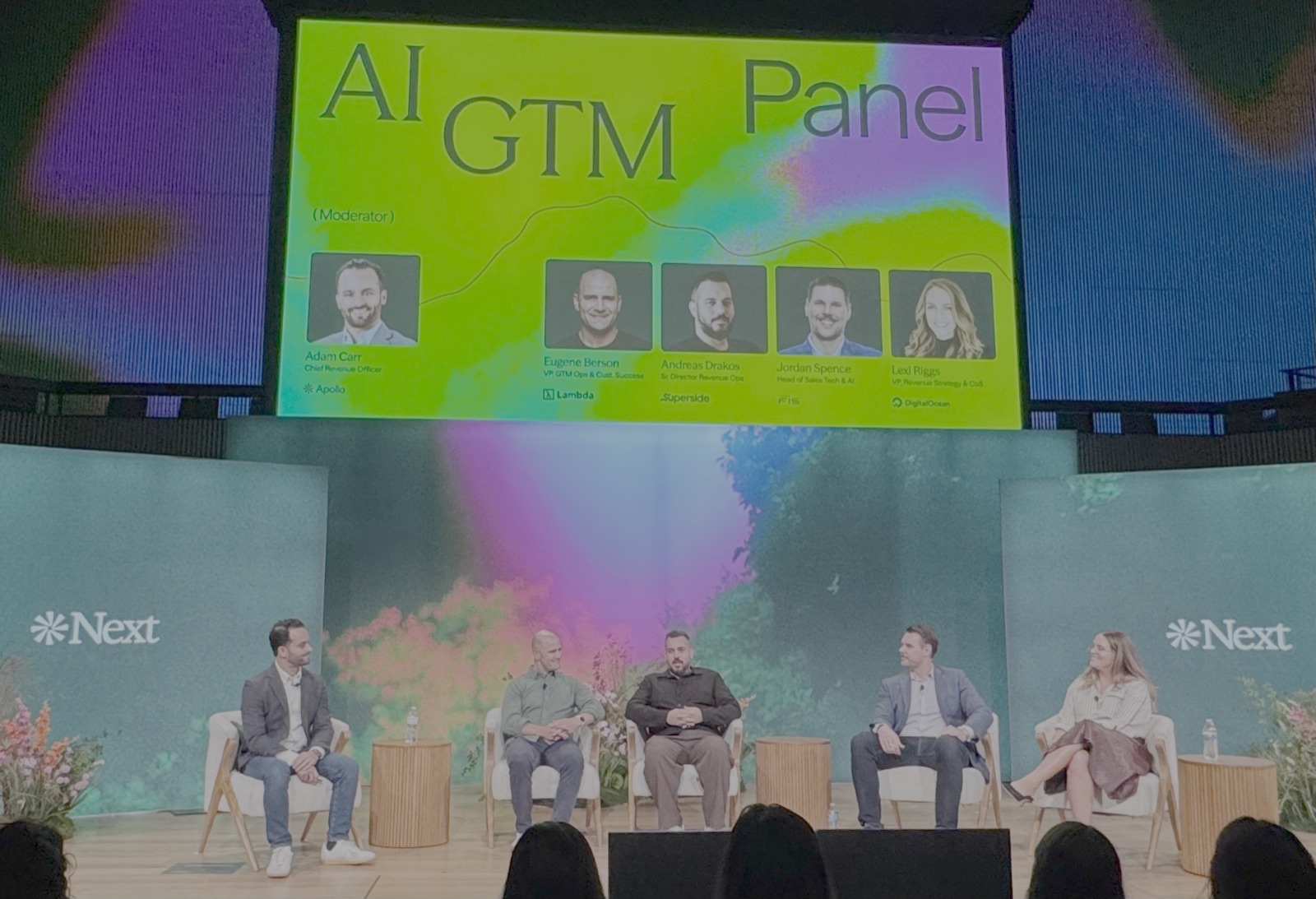
There was a less glamorous message, too. Eugene Berson, VP, GTM Operations and Customer Success at Lambda, described the work of turning individual experiments into something a whole organization can use: consistent data access, security, ownership, and a feedback loop. Chris made a related build-versus-buy argument: smaller teams should use mature platforms for common infrastructure and build the final portion that differentiates their business.
Even the live 30 Minutes to President’s Club session reinforced the limit of automation. Across the 18 tactics for moving deals forward, Nick Cegelski, founder of 30MPC, described a seller’s job as getting “the truth,” not the optimistic answer. Better account intelligence can prepare that conversation. It cannot have the difficult conversation for you.
Apollo’s all-in-one promise has a cybersecurity limit
My concern is not that Apollo lacks features. It has an extraordinary number. My concern is where the remaining gaps sit.
Technographics: a gap you can fill
The first is technographics. An Apollo solutions engineer explained to me that Apollo may show fewer technologies than a broad detection provider because it tries to validate actual usage. I respect that choice. For many cybersecurity products, though, targeting depends on knowing whether an account uses a specific cloud, identity, security, or infrastructure tool. Broad categories are insufficient, and Apollo’s coverage is too shallow for that job.
This gap is solvable. Providers such as TheirStack and HG Insights offer deeper technology data that teams can bring into their account workflows. Before building campaigns around those signals, I would check a sample of accounts whose technology stacks I already know. A false or outdated install makes for a bad targeting decision and an even worse opening line.
LinkedIn: a gap at the heart of the sequencer
The second gap is more consequential for my buying decision. Apollo’s sequencer supports LinkedIn steps as tasks. Email steps can run automatically. LinkedIn steps do not. In the cybersecurity marketing programs I work on, LinkedIn has proven more effective than email, especially when combined with email and calling.
The practical difference is a sequence that can warm up a prospect on LinkedIn, send a connection request, and then follow up through LinkedIn, email, or a call based on what happens, all with the steps and results visible together. That is the kind of workflow I want from a core sequencer.
Apollo’s approach is understandable given LinkedIn’s restrictions on unauthorized automation. Those restrictions are a risk with any automated alternative. Even so, the lack of automated LinkedIn steps remains a deal killer for me when choosing an all-in-one platform. I want to plan those touches and see their results on the same canvas. I could connect a separate LinkedIn tool to Apollo, but then I am back to coordinating two execution systems, their logic, and their results. That gives up a large part of the simplicity Apollo is selling.
If LinkedIn is similarly important to your outbound motion, there are two types of alternatives worth examining:
- Software-first platforms: Lemlist, La Growth Machine, Reply.io, and others offer LinkedIn and email sequencing with automated LinkedIn actions.
- Platforms with high-touch services: DemandCompass pairs account scoring and routing with operator-led outbound; Spear focuses on LinkedIn-led outreach and human reply handling.
Apollo may well become the center of a cybersecurity team’s GTM stack. With this gap, I would not treat it as the entire stack.
Where we may be at the next Apollo Next
The panelists’ predictions were more useful together than separately. Quoc Tran, RevOps lead at Replit, predicted that conventional SaaS interfaces will recede as teams build their own views on top of APIs and shared data. Chris Thompson expected building itself to stop being a differentiator. Tessa del Rio cautioned leaders to decide which customer-facing work should remain human. The AI GTM panel raised the cost, security, and reliability questions that arrive when experiments become infrastructure.
My take: a year from now, fewer teams will win because they know how to stitch technologies together. That capability is becoming easier to buy or build. The advantage will come from knowing which question to ask, which workflow deserves to exist, whether its data is trustworthy, and whether it works securely across the business rather than for one inventive employee.
Apollo Next showed how close advanced GTM capabilities are to becoming ordinary. It also showed why access to those capabilities is only the beginning.
At Clay Sculpt 2026, I explored how Clay is connecting data, agents, and campaign results into a system that learns.